The Economics of Agentic AI Risk
Why Governance Matters
By Sharon Eilon
Chief Revenue Officer, Eve Security
The New Economics of AI Adoption
AI is no longer experimental, it’s operational. Enterprises are deploying Agentic AI systems that make decisions, interact with core business systems, and perform tasks autonomously. This shift is transforming productivity, but it’s also introducing a new form of runtime risk, one that traditional cybersecurity models were never designed to manage.
According to Gartner, by 2026 over 60% of enterprises will run autonomous AI systems in production, yet fewer than 20% will have formal controls to govern their behavior.
The imbalance between AI adoption and AI oversight has become an economic risk multiplier, one that can quietly erode the ROI that AI promises.
Why AI Risk Is an Economic Problem
Security leaders have long viewed risk as something to mitigate. But with Agentic AI, risk itself becomes a financial variable.
These agents are not just software, they’re decision-makers. They access systems of record, move data, and take actions that affect revenue, compliance, and reputation. That means unmanaged AI risk directly translates into financial exposure.
Every AI-driven error, policy violation, or data misuse has a cost.
The only question is whether that exposure is being measured, or left to compound unseen.
The Four Economics of AI Risk
1. AI Risk Equals Financial Exposure
Each AI agent in production carries a quantifiable potential loss. A misrouted transaction, an unauthorized data pull, or a hallucinated response can all lead to immediate monetary or regulatory impact.
Governance provides the visibility and quantification needed to treat this exposure like any other form of enterprise risk:
-
measurable
-
manageable
-
reportable to the board
2. AI Incidents Are Non-Linear Cost Drivers
AI systems operate at machine speed and scale, meaning one failure can trigger a cascade of downstream effects.
A single flawed output might propagate across APIs, update multiple systems, or affect thousands of users simultaneously. This makes AI risk non-linear, small governance gaps can lead to outsized losses.
Runtime governance, especially with anomaly and intent detection, acts as a circuit breaker that limits the blast radius, keeping control costs stable even as autonomy expands.
3. Governance Reduces the Cost of Innovation
Without runtime assurance, enterprises often rely on manual reviews, restrictive policies, or delayed deployments to manage risk. That friction carries an opportunity cost.
When governance is embedded, through policies, automated controls, and agent-in-the-loop mechanisms, organizations can innovate faster with less overhead.
Governance becomes a productivity multiplier, not a bottleneck.
Every automated control is one less human check, and every saved approval cycle is measurable economic value.
4. Governance Protects Enterprise Value
Trust is the currency of the AI era. A single misaligned or opaque AI decision can erode brand equity, customer confidence, or regulatory standing overnight.
Enterprises with strong governance frameworks will enjoy:
-
higher resilience
-
lower cost of capital
-
greater trust from partners and regulators
In economic terms, governance doesn’t just reduce risk, it preserves enterprise value.
Governance as an Enabler, Not a Barrier
At Eve Security, we believe governance is not about slowing down, it’s about scaling safely. Eve secures the runtime use of Agentic AI, delivering the controls needed to enable innovation with confidence:
-
Visibility: Complete topology mapping of AI agents and the systems they access
-
Policy Control: Defining and enforcing “safe behavior” in real time
-
Risk Detection: Identifying anomalies and intent, even within policy limits
-
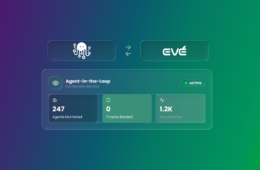
Agent-in-the-Loop: A security agent that interrogates risky or ambiguous actions before they execute
This isn’t about restricting what AI can do, it’s about ensuring it does what it should.
By turning governance into a runtime capability, organizations move from reactive risk management to proactive risk economics, quantifying, prioritizing, and controlling cost dynamically as agents operate.
Governance as a Competitive Advantage
As regulators, investors, and customers increasingly demand AI accountability, enterprises that can demonstrate effective AI governance will lead the market.
They’ll innovate faster because they can trust their systems.
They’ll comply faster because they can prove oversight.
And they’ll win faster because they can operate with confidence under scrutiny.
Governance, once seen as a compliance checkbox, becomes a strategic differentiator, a signal of maturity, trustworthiness, and operational excellence.
Closing Thought
AI is transforming not just how enterprises work, but how they account for risk. The economics are clear:
Unmanaged AI risk compounds. Governed AI scales.
The organizations that win in the age of Agentic AI will be those that see governance not as a constraint, but as a financial strategy for sustainable innovation.
Because in the end, governance isn’t the cost of control.
It’s the control of cost.